Sunday, July 14, 2013

The Encounter


What is the sense of place? Through the hand-pulled print and the photograph, I examine the intersection between the individual and nature in the experience of particular places.   Social, cultural, and historical trajectories sometimes collide at these moments of the encounter.  My work explores the complexity of lived experience, in terms of immediate materialities, the nature of perception, and apparent absences. By various means and through multiple approaches, my work investigates the act of experiencing place from different points of view. Each image thus expresses an element of experience.  I create productive tensions between orientation and disorientation, frozen moments and duration, original and copy, image and text, in order to re-imagine and find meaning in my relationship to the world. The muttivalent character of my creative explorations shows a complex negotiation between idea, materials, historic fact, perceptual nuance, and mediated image. These encounters convey an existential uncertainly about my place in the world.  Finding place is in a sense, then, about finding myself. Nature, culture, and self are all part of the experience of place. This is where I unfold the meaning of presence.
The Event of the Red Cup
I begin with Kendaia, a historic place in upstate New York. My home is just a twenty minute drive away. I am here to visit the site of an old Iroquois village ravaged by Generals Sullivan and Clinton in the late 1700s, during the era when colonists were expanding their power and control over areas of the Northeast.  I initially drive past the site without seeing the NYS marker nor the stone monument that are there.  The presence of a picnic table, no littering signs, and two markers indicating State Park property verify that this is the place I am seeking.  For material evidence of the Iroquois who once lived here, there is nothing.  I know that the Iroquois sided with the British during the Revolutionary War.  I know of the Sullivan/Clinton Trail that follows the eastern shore of Seneca Lake, snaking past my house on Route 414, where another NYS marker is placed acknowledging the Iroquois site Con-Daw-Haw. The Kendaia monument mentions the hostile Indian nations whom the commemorated Generals were sent to abolish. A map of the region shows the trail of scorched earth established by the orders of President Washington. I am not convinced that the monument's commemoration tells the whole story. I wander around the perimeter of the mowed lawn of the site, alone with the entanglements of tree, detritus, stream, wild raspberry and grapevine, blue sky, fresh air.  A flicker of red appears--a red cup.  It is somehow not surprising, maddingly unfortunate yes, and certainly out of place.  The no litter signs should have been adequate to remind visitors of their responsibilities.
But then something else about the red cup halted my wandering. The uniqueness of the moment where the red cup, me, the absent Iroquois, trees, blue sky, picnic table, and state park converge in this place. I needed to understand how this is to be; what were the reasons for both the absence of material history and the presence of a red cup to appear in this paradoxical fashion, demanded my attention.  Questions about place as an eventmental site for the production of meaning became clear.  Historic memory, perceptual experience, and the mediated image become the focus of my work.  The red cup is both the end and the beginning of the journey.

Wednesday, May 29, 2013

Kendaia Series

I have been working on this series Kendaia for most of the semester.  Kendaia is an Iroquois site about 20 minutes from where I live.  This place is a multivalent confluence of historical, cultural, and historical events, and in the words of philosopher Edward Casey is "eventmental".  This series  I use my own documentary photographs as a record of the site, which then are further mediated through a paper lithography process, where each color is separately printed, layer over layer.  The mediation reflects the layered content of the site. The printing process causes a perceptual blur, which obscures the visual definition of the various elements in the image. In each print I also include a bit of trash -- a cup, a bottle, cans, styrofoam, or a cigarette case. Perceptually the space is vibrantly alive with texture and color, but it also includes inherently these odd inclusions.  This "horizontal" portrayal of the materialities of life are juxtaposed with ghostly skin-like drawn forms that are sewn on, transparently revealing the ground beneath.  These images beg the questions: What is real? What is seen or not seen? Who is seeing? Are we in a suspended moment of time? 

Here is a peak of some of them.  They are still a work in progress, and will hopefully be completed by the June residency!  There are seven of them in this series.  A second taller (67 inches) Kendaia series with eight panels will be coming soon as well!  I wish I had another month to finish all of these!


Wednesday, May 15, 2013

Kendaia -- Skins, Topographies, and Horizons

Kendaia is a site.  Pascal is quoted as saying, "Nature is an infinite sphere whose center is everywhere and whose limits are nowhere."  Robert Smithson sees the world similarly, as a kind of unedited text, remote, without logos, and undefined.  I am fascinated by Kendaia for a number of reasons, but primarily because it is undefined in this sense.   On the other hand, like an archeologist, I performed a visual mining at the site, where I have collected, through the use of photography, images that are the skins of experience.  Robert Smithson, too, selected materials from the sites to create his non-sites, which represent a focused articulation of part of the actual site.  In the same way, I choose to articulate some specific elements through the idea of skins, topology, and horizons. Each skin-form rematerializes the aspects of the site to give meaning to the sense of place. 

Below are three projects I have recently finished.  "Skins" is a family of columnar paper constructions of photographs from Kendaia.  Each image is a xerox on large paper saturated with pigmented encaustic.  They are translucent, fragile, and entirely contingent on one another for support and visual impact.  Each image shows the ground littered with leaves, branches, stems, and debris, tossed from car windows or left there by passersby. 


The second series are Skin Topographies, paper painted on both sides, folded, and curled matrices saturated with clear wax, which are hung as low reliefs from the wall.  These give expression to an alphabet of forms that individually show presence, and appear together as an alphabet of forms like a visual sentence about Kendaia.  They are the photographic reconfiguration of the horizon, then reconstructed in Photoshop to reflect the same horizon as its mirrored image.  Each topographic form has both horizons.  The picture plane is rematerialized into embodied forms as part of another language.


Finally, the last piece is a compilation of views, the same series of stills of the horizon at Kendaia, but juxtaposed and arranged sequentially.  The horizon is again mirrored in each still.  The scroll, then, was immersed in clear wax, and a red thread was sewn along the two horizon lines -- in honor of the Two Row Wampum of the Haudenosaunee. The scroll is self-standing, translucent, reflective, and in the round.


Sunday, March 10, 2013

Chelsea Galleries & El Anatsui at High Line

This weekend my husband and I went to NYC again.  After meeting with my mentor Marc Handelman, we ventured into Chelsea to see some galleries. Galleri Lelong hosted a small but great show of work by Arte Provera artists Luciano Fabro, Jannis Kounellis, and Mario Merz.  Fabro's marbleand gold leaf piece and Kounellis' coal/steel/wire piece and his burlap sacks with steel were especially intriguing.


Robert Miller Gallery was showing the collaborative show of South African Beezy Bailey and Dave Matthews.  Based on a video taken by Dave Matthews of Beezy performing in a fatman suit, Beezy created a series of mixed media pieces that contain elements of painting and printmaking. They seemed to explore the issue of identity and alter ego.


The International Print Center New York hosted their New Prints 2013/Winter show which had an uneven collection of prints.  Nicola Lopez large Infrastructure print was great to see, as were some more sculptural pieces.


The Heller Gallery exhibits only glass artists, some of whom work at Corning Glass near where I live.  A wonderful video showed the glass artists producing some very beautiful pieces, some of which were on display in the gallery.


Lastly, we had a chance to see El Anatsui's largest piece ever which he recently installed at the High Line. He used a combination of rusted metal pieces and mirrors to reflect the sky and buildings.


El Anatsui at the Brooklyn Museum

My two most recent visits to New York City to meet with my new mentor Marc Handelman, who has his studio in Brooklyn, provided wonderful opportunities to see some great exhibits.

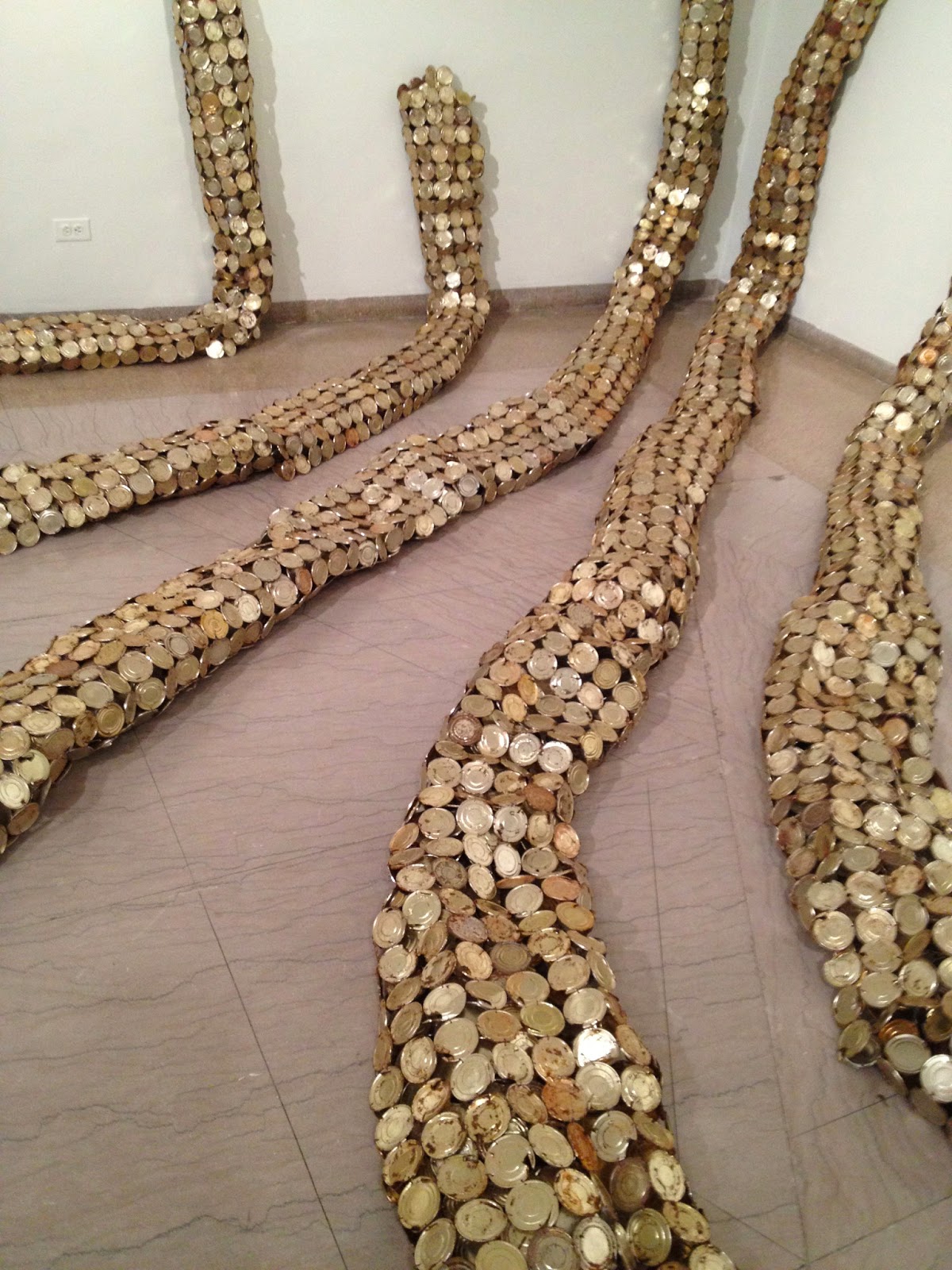
The monumental pieces by El Anatsui at the Brooklyn Museum are fantastic in every way.  Like the Arte Provera artists, he uses found materials like bottle caps, rusted metal, paint can lids, old newspapers, etc to construct these huge tapestry-like sculptural forms.  These simple materials are transformed into poetic statements that read like topographic landscapes that shimmer with gold or silver, and hang with a sense of weight and mass.  Some hang directly from the wall or from the ceiling.  The central installation consisted of delicate lattices of woven metal hung like gigantic drapes or sheets that revealed passersby but intersected the gallery space with curious obfuscations and overlays of textured woven material.  Materiality was key, so despite the monumentality of the artwork, one is very aware of the small bottle caps and wire used to assemble the enumerable pieces that form the massive hangings.  Just as impressive were the paper bag series of self-standing bag pieces, larger than life, like Stonehenge or ancestral monuments for the consumer industry.  The snake-like sculptures that meander along the floor and part way up the wall, were intriguing as well. Here are a few images from the show:


Friday, February 22, 2013

Dallas Galleries

I had a great trip to Dallas last weekend to visit my son and to see some great galleries there.  Three galleries in particular were especially great: Cris Worley Fine Art, Holly Johnson Gallery, and Galleri Urbane Marfa.

Gail Peter Bordon
The featured artist at Galleri Urbane Marfa was Gail Peter Bordon with his solo show entitled "Surface Structures", with resin enamel paintings on board or glass.  The minimalistic language and reduced forms of landscapes were saturated with the lush and poetic color intensities.  The surface structures were also painted on the curved surface of glass jars with the same level of color intensity.  The reference to perspective on a shaped surface presented a very interesting discourse about how we see architectural and geometric shapes in space.  See the following link to see his work.                   http://www.galleriurbane.com/gail-peter-borden.html


Randy Twaddle
Holly Johnson Gallery featured the fabulous drawings of Randy Twaddle.  All the drawings were done with ink and coffee stains! The telephone polls of Texas were featured, in silhouette against a flow of coffee stains of varying transparencies.  I loved these pieces.  

Trey Egan
Cris Morley Gallery featured the MFA thesis of Trey Egan.  He is a competent painter, and the surface treatment was impressive, but the painting did not sing for me. The Cris Morley Gallery, though, does seem to show many emerging and established artists you are working with many different materials and subjects.  I was excited to see the caliber of these artists and plan to visit the gallery again in the future. 

Excerpt


My newest print is finished!  As part of a portfolio exchange with the Limerick Printmakers of Ireland, this piece entitled, "Excerpt" is a combination print with reduction woodcut, screenprint, and monotype on Rives Lightweight paper and vellum; a bleed print 16 x 20", in an edition of 32. It was constructed in the shape of an envelope. The flap opens up to reveal a map of the Finger Lakes Region of New York State, screenprinted on a caution yellow background.  The text comes an excerpt from the Great Law of Peace, the constitution of the Haudenosaunee Confederacy, of the Iroquois Nations.  The tree graces the shores of Seneca Lake in the town of Valois.